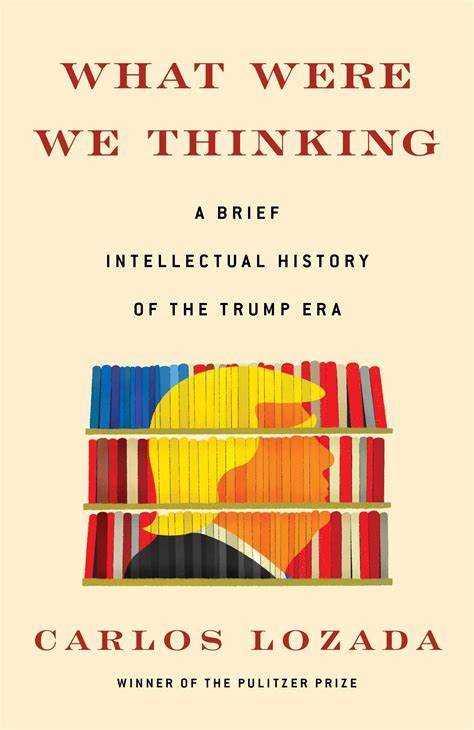
“Many books have been written about me, some good, some bad. Both happily and sadly, there will be more to come!”- Donald Trump
My project begins with Carlos Lozada’s How Did We Get Here? An Intellectual History of the Trump Era because it is a literature review, and a useful launching pad for my own project. Lozada states in the introduction that he has read around 150 books on the Trump era and has many more to read. His main goal is how we thought here. The intellectual history of the Trump era is expansive in scope and not only is this book too narrow a project to offer any profound or nuanced conclusions, the manner through which Lozada conducts his analysis is steeped in tired anti-Trump tropes. Examples of these are a focus on the white working class, when the working class in America is more than just white, and on Trump’s positions on immigration. Lozada dubs him anti-immigration when a more thoughtful approach would begin with the question, what is Trump’s policy toward immigration and is it successful/beneficial? Lozada makes his biases obvious. This weakens his analysis throughout the book, as his thesis sets up an approach that considers all views on Trump but he instead provides many categories that are anti-Trump, a couple that are critical left and right, and a few categories on the right that are so simplistic that Lozada clearly did not read much right wing thought on Trump. His take on Victor Davis Hanson’s The Case for Trump, and figured the entire right either endorsed, opposed, or rationalized Trump, with no in between. This is absurd and exposes Lozada’s bias though having this personally is fine, if you state from the outset of your project that you are striving to consider all views on Trump and then spend most of the time on particular views which you either sympathize or agree with this undermines that goal.
Carlos Lozada writes in his introduction that he strives to go beyond dogma and oversimplification in his review of the Trump canon. He expresses interest in “how we thought here” and writes that he will explore books on topics such as populism and authoritarianism. He remarks that the most significant books on the Trump era “are scarcely about Trump at all.” (2021) From the introduction, this literature review seems promising, however, Lozada is only interested in how certain people “thought here”. His biases are blatant in his reductive analysis of right-wing perspective on Trump, which is split into sycophants, those who try to fuse Trump’s policies that are seen as successes by the right, and those on the right who oppose Trump vehemently, the never Trumpers. There is a wealth of differing right wing views about Trump and what the legacy of him and his administration will be. The list of books that Lozada covers in this specific chapter is short and incredibly limited.
After introducing the three main categories of right-wing thought on Trump, Lozada writes that: “These disparate camps regard one another with a mix of accommodation and hostility, yet they share one essential trait: even as they obsess over Trump, they are in denial about him—who he is, what he means, or how he overpowered their party and movement.” (2021) Are they? Many on the right recognize Trump’s flaws and are aware that he is not of high moral character. This is where a wider reading of conservative positions on Trump would be helpful for Lozada. For example, National Review magazine published an issue excoriating Trump, and over the course of his presidency, many writers for the magazine offered criticism and applause for Trump and his administration. Ben Shapiro, a notable conservative commentator and co-founder of The Daily Wire, declared before the 2016 election that he would not be voting for Trump as he saw Trump as a danger to conservatism. However, in 2020 Shapiro cut a video before the election that he would be voting for Trump and dedicated an episode of his show earlier in 2020 to Trump’s accomplishments in both domestic and foreign policy. Glenn Beck, a commentator on The Blaze, a conservative network, made appearances on CNN and frequently said in his show during the 2015-2016 Republican primaries and presidential election that Trump is a dangerous figure, although he later grew to support Trump and lauded his successes and promises kept. These are just a few examples of figures on the right who were initially opposed to Trump, yet commended policy successes and ended up supporting him in 2020. Even during their support for him in 2020, they criticized Trump often for his rhetorical excesses and antics and disagreed with much of his policies. Where Lozada would see writers for National Review like Rich Lowry and commentators like Shapiro and Beck as having made a conservative pivot, the reality is more nuanced. Since Trump’s loss in the 2020 election, many on the right have been highly critical of his behavior, while there are others who share Trump’s idea that the 2020 election was fraudulent, and then there are some who wish to see the Republican party move on entirely from Trump. The right is not monolithic in its thoughts on Trump.
The right was forced to react and interpret Trump following his surprise election victory just like those on the left did, and those reactions varied. Lozada discusses three reactions in his chapter, and each is a mischaracterization. The sycophants, Lozada argues, “through a lack of options, imagination, or shame embraced the new order and relentlessly justified that decision.” (2021) The reality is more layered. There are figures like Ann Coulter who endorsed Trump early on in his candidacy in 2015, yet now express dismay in what she sees as con artistry. Many people like Steve Bannon, who ended up working in the White House briefly as Trump’s chief strategist, see Trump as a tool to advance goals that are far beyond Trump. The attachment of many sycophants is likely more tied to personal agendas or political goals through which he is a means to their ends. On the Never Trump conservatives, Lozada notes they opposed Trump right from the start of his candidacy, and they are in a tight spot where they are opposed by Trump’s base and his opposition. This is not accurate, as many who were once reviled by the Democratic party gained newfound adoration for their dislike of Trump, like Mitt Romney. The Never Trump conservatives are an anti-Trump sector of thought on the right. Their panicky reaction to Trump and the threat they see to their vision of a quaint and polite form of conservatism is like panic over Trump’s perceived threat to American institutions by the left and the Democratic party. In the section on conservatives who “found religion” after Trump’s election, Lozada injects his personal bias where he writes that not all conservatives “instinctively genuflect, look away, or insist that Trump and Trumpism are anything other than what they are.” (2021) What are they? It is evident what Lozada is implying, that Trump and Trumpism, whatever that refers to, are destructive and horrible, which though not completely inaccurate is an injection of bias. The sentiments of the Never Trump conservatives are shared by him.
On the category Lozada terms “pro-Trump conservative intellectuals”, he writes that they are “seeking to retrofit an ideological framework onto the whims of a man whose positions show few organizing principles beyond self-interest and self-regard” (2021) This is disingenuous at best, as those he mentions as proponents of this framework, Victor Davis Hanson, and Rich Lowry, were reacting to and interpreting Trump in their own way and from their own perspectives. Where Lozada sees an attempt to intellectualize Trump and ‘Trumpism’, there may just be an interpretation of Trump and his administration’s policies that differs from Lozada. His insistence that these conservative intellectuals retrofit their ideology onto the man is misleading. The policies thinkers such as Lowry and Hanson applaud, may be policies they agree with and have hoped to be implemented long before Trump. This again undermines Lozada’s claim that he is looking beyond Trump and focusing on ideas. In all three of his categories of the right on Trump, he analyzes how the right has reacted to the person more than the ideas these thinkers discuss- on whether Trump is supported, supplanted, or opposed.
Lozada exposes his bias in his conclusion to this chapter. He notes that Trump barely reads, and that part of his campaign was railing against established expertise. Thus the role of a pro-Trump intellectual is to intellectualize this mistrust of expertise. He writes in closing that, “where they do attempt to retrofit an ideology onto Trumpism, they end up putting a movement in service of a man.” (2021) What is Trumpism? Lozada claims that he has dipped into the conservative intellectual literature, yet he provides no definition of Trumpism. It is a meaningless term, a buzzword. The rage and disillusionment driving Trump’s popularity is about more than Trump. Rather than a movement in service of a man, this is a movement in service of despair and loss of trust in America’s political system. Lozada’s liberal bias is clear in the amount of space he dedicates to a focus on right leaning thought on Trump- a single chapter. A few other chapters in this book could include more conservative literature from the Trump canon. The opening chapter does include a few, like J.D Vance’s Hillbilly Elegy. Another chapter that would benefit from a reading across the political spectrum is the chapter on resistance literature. This is what I will cover in my next post.
References
Lozada, C. (2021). What Were We Thinking: A Brief Intellectual History of the Trump Era. Simon & Schuster.
 Not Without Incident: Questioning Big Brother's Platitudes
Leave a comment