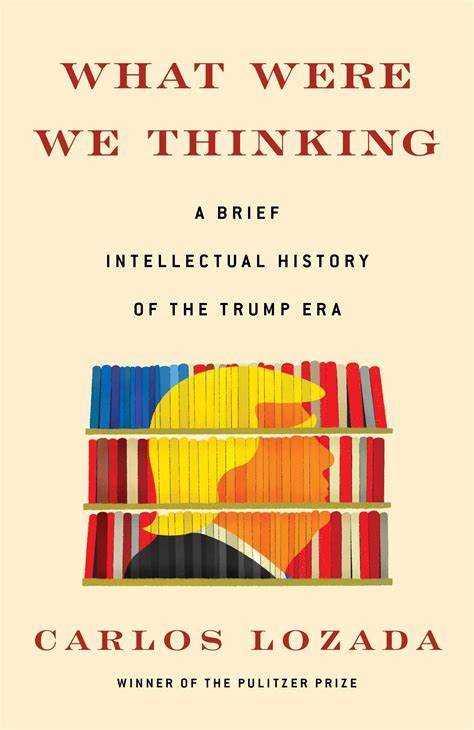
Carlos Lozada
The Chaos Chronicles
“The tyranny imposed on the soul by anger, or fear, or lust, or pain, or envy, or desire, I generally call ‘injustice.’”- Plato
“I blame Michael Wolff”, writes Lozada introducing his chapter on what he deems the “chaos chronicles” (2021) He blames Wolff for establishing the framework in which all the books which present chronological and dramatized narratives of the Trump presidency follow. This blame is misplaced, and the category mistitled. Wolff is not to blame for the insatiable hunger people have for accounts from inside the Trump White House that affirms their assumptions that it is a chaotic mess. Wolff simply wrote a set of books that fed this desire to hear of the chaos they knew was happening. The truth of events was secondary to affirming these assumptions. Lozada notes that shocking anecdotes recounted in the books of Wolff and others are no longer surprising and have lost their shock value by the time the next book is out, which is perhaps an attempt to outdo the last one depicting a madder-man in action. There is a hollowness to these books, driven by the fact that anecdotes and narratives presented are based on hearsay and interviews with anonymous staffers and can have been easily exaggerated or misinterpreted. There is a willing audience for the retelling of these ‘happenings’ from readers who despise Trump and feel that he assaulted the American political system each day he resided in The Whitehouse. This hollowness is never probed, and the writers of the chaos chronicles, at least the ones who consider themselves journalists, must know this. What is created is a body of literature that operates more as a confirmation of a particular narrative about Trump. This goes both ways, as while there is an ever-growing anti-Trump body of these texts, there is also a pro-Trump literature thread that hails Trump as a messiah or a fighter against the ‘Deep State’. Within these polarized bodies of literature echo chambers are reinforced and much of the division and polarization that Trump was powered by and thrived on is thus perpetuated.
Lozada is incorrect in where he lays the blame for the chaos chronicles. The blame more accurately lies with outlets such as his, The Washington Post, who saw Trump as a profit driver and a distraction from covering salient issues. There is a deep cynicism embedded in the coverage of Trump, one that is replicated in the texts by writers and commentators from the same outlets whose coverage exploited not just Trump’s presidency, but the political opportunities it presented to liberal and conservative press. Lozada’s unwillingness to grapple with the impact liberal outlets had on trust and belief in American institutions is a blind spot that could see a replay of 2016 in 2024. The critiques he makes of Wolff’s book can all be made of The Washington Post, The New York Times, The Guardian, MSNBC, CNN, ABC, NBC, and others who relentlessly scrutinized Trump’s every step, from the Diet Coke button on his desk to him getting two scoops of ice cream on his cake versus his advisers getting one scoop. This resulted in absurd headlines and reporting that distracted from substantive coverage, led to shoddy reporting, lack of accountability for mistakes, and even overt ignoring and censorship of stories that may hurt Democrats, such as the Hunter Biden laptop story or revelations from John Durham’s probing of the Russia investigation. Lozada reveals his own complicity in this cynical coverage where he writes that, “I believe it. I believe all of it and more. That’s the trouble with writing about the Trump White House, and reading about it, too: the lunacy is appalling yet unsurprising, wholly unpresidential yet entirely on-brand.” (2021). This is the point, Lozada believes it and this shows he, like anyone who hates Trump with a passion will be susceptible to believing untruths about Trump so long as they conform to a preconceived narrative.
The instant Trump was elected it was assumed America, and the world, was in for a chaotic four years. The chaos chronicles affirm this worldview, and Lozada’s analysis of this section of the literature is blinded by his bias as, openly admitted, he is apt to believe wholeheartedly many of the anecdotes leaked from the Trump White House. The unwillingness to wait and verify stories is a problem which plagued coverage of the Trump presidency. A fairer analysis of the chaos chronicles would be to take Lozada’s concept and rename it, then expand it to include excessively negative and positive news coverage of Trump and work by commentators that contains a blatant bias. This would include Lozada’s own work for The Washington Post, who, though he claims to be writing from a more distant perspective, has expressed an anti-Trump slant in his work, which he won a Pulitzer Prize for. (2019) This is not to dimmish his accomplishments nor is it a personal critique, rather, the ideas espoused in Lozada’s writings are of a specific bias. A couple of the judges who sat on the panel are themselves from liberal outlets. (2019) Instead of chaos chronicles, which sounds like a thriller novel series, a more fitting categorization would be a section of the anti-Trump literature that dramatizes reporting and anecdotes from the Trump presidency. Giving these texts their own category isolates them from texts and commentary written by media outlets and thus exonerates the role outlets, both on the right and the left, played in perpetuating conflicting narratives about the Trump presidency. It is understandable that Lozada does this, as the outlet he works for would come under criticism, as well as outlets that participated in anti-Trump narrative bolstering such as the New York Times and The Guardian. Lozada fails to offer a nuanced commentary on the texts he refers to as the chaos chronicles. Blaming Wolff for the template these texts follow is inaccurate, as it is the anti-Trump narrative presented by the liberal press that set the template.
This template Lozada criticizes as now cookie cutter is rooted in much of the sentiments that drove the resistance to Trump, rooted in a rage that is inflamed by overly negative media coverage. To see an example of this rage and terror inducing coverage one only needs to search 2016 election night reactions to view various compilations of news hosts and commentators crying, screaming, and speaking with solemnity over the impending doom about to overcome America. Immediately, reporters and news host whose job it is to report the facts and omit personal politics as much as possible, became awash with indignation and grief. This overreaction is frequently referred to as Trump Derangement Syndrome (TDS) in informal circles. Howard Kurtz, who writes in his book Media Madness about the media’s reaction to the Trump presidency, refers to this overreaction as “Trump Trauma” (2018). It is this trauma that describes how liberal media reacted to Trump’s victory and his subsequent presidency, where it was declared openly that Trump must be covered differently than any other administration. While it’s true that much has changed in the political landscape, notably the role social media outlets like Twitter play in politics where instead of reflecting on what could have led to Trump’s victory and then trying to cover his presidency as fairly as possible, allowing for the coverage of failures as well as successes, outlets like CNN and MSNBC were intent to present Trump as a cartoonish villain while outlets like Fox and Breitbart often cheered Trump’s every move and attack on his opposition. The reinforcing of social media echo chambers, which create divided realities and distort the ability of people to discern what is fact or fiction is detrimental to a democratic society and is a massive boon to a leader such as Trump, who thrives on division. Lozada exists on one side of this self-perpetuating media divide, and he is evidently unwilling to acknowledge his role. He is thus susceptible to blind spots when it comes to covering the Trump administration.
An example of such a blind spot is Lozada’s brief discussion of ‘Anonymous’, an alleged senior Trump administration official who took his criticism and gripes with the administration public in a piece in the New York Times, and then wrote a book describing the chaos that shook the White House daily. In a 2020 statement, Anonymous identified himself as Miles Taylor, who it turns out was the former chief of staff in the Department of Homeland Security, not a staff member in Trump’s immediate orbit. (2020) The way Anonymous was covered was as if a staffer close to Trump was, in an act of heroism, revealing that yes, things were as awful and messy as many assumed to be the case. The way Lozada analyzes this text illustrates his bias and role in covering the Trump presidency. It reveals a lack of verification and relying on information affirming a particular narrative about Trump. The reiterating of Anonymous’ account also shows a lack of accountability on the part of those who produced information critical of Trump that was implausible or false. There was a constant push to move onto the next story, and little to no concern with truth. Lozada has not gone back and made a correction, as Anonymous’ identity was revealed a few days before Lozada’s book was first published. (2020) There is no incentive to admit mistakes or to retract stories that turn out false or misleading. In this case Anonymous revealed himself to be Miles Taylor, who was the chief of staff to DHS Secretary Kirstjen Nielsen and claimed to be a member of the resistance within the White House. Taylor initially lied about being Anonymous in an interview with Anderson Cooper on CNN. (2020) The hype around his claims on there being a resistance inside the White House, a group of secret heroes working to keep Trump in check, was jumped on not in the interest of truth but of narrative affirmation. Taylor satisfied the urge in people to know that the resistance to Trump was a force that existed all around Trump, even in his orbit. Never in the reporting on claims made by Taylor, then Anonymous, was there an interest in verifying his closeness to Trump or his stories of an inside resistance (In the liberal media, right leaning press either noted the claims of Anonymous dubious or sided with Trump’s own outrage over the major leak). Lozada admits that the account that Taylor gave as Anonymous was vague and that the writer could have been anyone. Lozada writes that “Readers did not learn anything about the work the writer had done or which impulses, if any, had been thwarted. The article’s generic op-ed-speak—its comforts were cold and its divides bitter, its observers were astute and its heroes unsung—also made it hard to identify the author.” (2021). Thus, if the writer was hard to identify, why the hype? It could easily have been a troll. Lozada notes the typical characterizations of Trump outlined in the article and book published by Anonymous, and in between he writes, “As if we did not know” (2021). This is important, as Lozada reads much of the criticisms from Anonymous as self-evident. The narrative Lozada is predisposed to believe about Trump’s governing is affirmed to the point of it being banal in its telling. This is part of a much larger issue, jumping on all White House leaks so long as they affirm the anti-Trump narrative, and not remaining skeptical of claims until hard evidence is provided. If Lozada were interested in holding to his goals outlined in this book’s introduction, he would set his biases aside, and his use of this specific text illustrates that he has not done this.
Lozada concludes his chapter on the chaos chronicles with a brief analysis of Robert Mueller’s report on the Russia investigation. He writes in closing that “as the Chaos Chronicles show, is that those “burdens on the President’s capacity to govern” have been overwhelmingly self-imposed.” (2021) Self-imposed? This exonerates the role the media has in pushing this investigation, including the Washington Post, which recently retracted some of its reporting on the Steele Dossier. (2021) The Russia investigation being the center piece for many of the chaos chronicles, it being bogus and possibly an attempt to undermine Trump by the Clinton campaign leaves much to be desired in Lozada’s writing, as he does not include books such as Ball of Collusion, which offer a differing narrative of the Russia investigation. Though Trump did himself no favors in reacting to the investigation in the way he did, to say he obstructed justice is an oversimplification, if no justice was being carried out, what was he obstructing? Lozada’s unwillingness to confront critiques of this and other narratives show a slant in his approach. His claims to be seeking nuance are laughable. Lozada’s analysis in this chapter shows that he is more intent on entrenching his political biases in covering Trump than he is in offering a fair and nuanced approach.
Next week I will look at Lozada’s chapter of the book on Truth and its supposed death in the aftermath of Trump’s election and term in office and expand on ideas I have touched on in this post such as narrative affirmation and laundering and show how Lozada’s bias is often covert. This is an issue that pervades much of the anti-Trump and pro-Trump literature. Truth is malleable and is employed to serve certain narratives and political sides.
References
Cable News Network. (2020, October 28). Read Miles Taylor’s statement on being the ‘anonymous’ op-ed writer. CNN. Retrieved March 12, 2022, from https://edition.cnn.com/2020/10/28/politics/miles-taylor-trump-op-ed-statement/index.html
Farhi. (2021). The Washington Post corrects, removes parts of two stories regarding the Steele dossier. The Washington Post.
Kurtz, H. (2018). Media Madness: Donald Trump, The Press, and The War Over The Truth. Regnery Publishing, a division of Salem Media Group.
Lozada, C. (2021). What Were We Thinking: A Brief Intellectual History of the Trump Era. Simon & Schuster.
Tapper, J., & Herb, J. (2020, October 29). Author of 2018 ‘anonymous’ op-ed critical of Trump revealed. CNN. Retrieved March 12, 2022, from https://edition.cnn.com/2020/10/28/politics/anonymous-new-york-times-oped-writer/index.html
The 2019 Pulitzer Prize Winner in Criticism- Carlos Lozada of The Washington Post. The Pulitzer Prizes. (2019). Retrieved March 12, 2022, from https://www.pulitzer.org/winners/carlos-lozada-washington-post
 Not Without Incident: Questioning Big Brother's Platitudes
Leave a comment