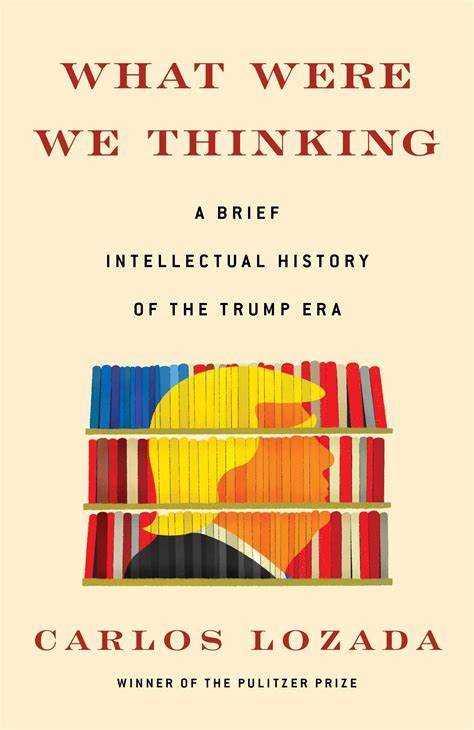
Carlos Lozada
True Enough? Part One
“Honest is how I want to look. The truth doesn’t glitter and shine.”[i]– Chuck Palahniuk, Survivor
“Truth is a matter of the imagination.”[ii]– Ursala K. Le Guin, The Left Hand of Darkness
Truth is more elusive than ever before. The reality we all shared until yesterday has been upended and gender, the role and nature of Western civilization, and many other concepts and ideas have been radically redefined. We are now well into the post-truth era. When did this era begin though? Trump is seen as a distinct attack on truth and his brand of lazy, apathetic, and often inane lies, like the number of attendees at his inauguration, are proof of this. Carlos Lozada recognizes the main difference between Trump’s lies and the lies of the Bush presidency- the motivation behind them. He writes, “Bush hoped to remake the world. Trump just makes it up as he goes along.”[iii] However, Lozada fails to explore the lies spread by the Clinton and Obama administrations, which paved the way for Trump and enabled him to present his vision of America under the establishment Republicans and Democrats as a dystopian nightmare as an appealing alternative to millions of Americans who feel they live in such a nightmare. Clinton, after two years of attempts at change making, was hit by a red wave in the 1994 mid-term elections and he then proceeded to transition the Democratic Party from a party for the working class to a party for the professional class, what is now the keyboard class. Many of the policies his administration put in place led to the housing bubble bursting in 2007-8, like the revisions to the Community Reinvestment Act (CRA) of in 1995.[iv] The lie that Clinton was amazing and represented the working man, which he proclaimed in his speech introducing NAFTA, is apparently passable, in fact, there is a nostalgia for the days when politicians would lie in convincing and charming ways. On the contrary, these lies are incredibly destructive and the continued refusal to grasp the impact that the shift taken by the Clinton administration after 1994 had on the makeup and image of the party is part of why they are failing to connect with disillusioned voters. The lies of the Bush presidency are even more destructive. The wars they entered under the guise of democracy promotion marked the beginning of the unraveling of American empire. Neoconservatives like Charles Krauthammer and Max Boot saw the implementation of their ideas as the US proving itself a force for good in the world. The US was a kid in a sandbox, knocking over sandcastles and throwing deathly toys at anyone deemed affiliated with the axis of evil.
The lies of the Obama presidency are the most destructive of all, as the lie that he was to be a harbinger of profound change akin to FDR was proven false in the election of Trump. The Obama administration bailed out the banks that had destroyed lives across the country, entered more wars, toppling Qaddafi and accelerating the use of drones. The declining turnout for Obama in 2012 and Clinton in 2016 reflects the citizenry’s disenchantment with his hollow messaging. Lozada focuses his attention on Trump’s lying and the books he is discussing all do the same. His analysis is thus myopic and the solution from this logic that emphasizes Trump as the sole cause behind the post-truth era would be to erase Trump, which Silicon Valley has done in a disturbingly quick and complete manner, and then to supplant in the minds of his supporters the set of lies the Democratic party seeks to inculcate. In the title of this section, ‘True Enough’, Lozada is directly referring to Trump’s lazy mistreatment of the truth.[v] He lays out the focus of his analysis when he writes: “Among the battlegrounds of the Trump era, the cheapening of truth has drawn some of the most impassioned responses.”[vi] Lozada limits the battleground to the Trump presidency, 2017-2021, and this is ridiculous. Truth was cheapened and bastardized long before Trump ever considered running for president. The war for the truth is ongoing and Lozada feels he and those behind much of the literature he is reviewing are on the right side of the war on truth, and this is a fantasy. Trump’s opposition engages in lies and deception through methods more dangerous than Trump. He does not hide his corruption and makes no efforts to self-correct when his lies are falsified. For many voters this is a welcome break from decades of slimy politicians willfully deceiving and manipulating the public behind closed doors. On this myopic literature, Lozada writes: “These works succeed in finding patterns in, and methods to, the onslaught of the president’s falsehoods…but even some of the most pessimistic authors have struggled to anticipate the extent of Trump’s manipulations or interpret their impact.”[vii] This narrow focus on Trump’s lies robs us of an opportunity to discuss why such fantasy is viable in national politics. If voters are given a selection of liars, thieves, warlords, and corporate pillagers, why not choose the guy who opts for catchy epithets for his opponents, from ‘Crooked Hilary’ to ‘Sleepy Joe’, rails against ‘fake news’, and wonders if the border around the US should be stocked with alligators? The post-truth era did not begin on January 20th, 2017, neither did it begin when Trump announced his candidacy on June 17th, 2015. It began long ago. Eisenhower’s warnings about the entrenched power of the military-industrial complex echo louder and louder. Kellyanne Conway, a Trump acolyte who recently published a book on her work in the White House, claimed early in the Trump presidency that he was engaging in ‘alternative facts’.[viii] Trump’s fantasies, whether it’s the attendance at his inauguration or the 2020 ‘stolen election’, are alternative lies. Lozada misses an opportunity to explore the appeal of Trump’s lies and conspiracism, and how the Democratic party is as, if not more, guilty of lying and deceit. If Hilary Clinton had won the presidency in 2016, I’d venture to guess that not only would Lozada have no literature on which to base his review, nor would the event that led to it have happened, but he would be praising the wonders of having an honest, caring, and wondrous woman president.
Lozada touches on the role of post-modernism, which is crucial to understanding the culture war issues that fuel the surface level squabbles that overtook coverage of the Trump presidency, especially in academia where hating Trump is a surefire way to get published and lavished with praise as a gallant scholar, and proud member of the #resistance. The falsity that Trump’s lying is aberrational is absent from Lozada’s analysis. This may be partially because of his outlet’s role and politics during the Trump era. An example of this is his mention of the absurd chronicled Washington Post fact checking, which did not bother to monitor the endless lies spewed by the Clinton’s, the Obama’s, the Bush’s, or the liberal corporate media.[ix] Magical thinking, an escape from an increasingly nightmarish and sordid world will only become more attractive as the Democratic party stick their heads in the sand, ignoring their failings. Lozada falls into these same failings. At the end of the chapter, he even expresses annoyance at the thought of introspection.[x] He remarks that in Lee McIntyre’s book Post-Truth, McIntyre “offers some annoying advice”, which is to self-reflect and to constantly question within ourselves whether we have the truth and the facts or not.[xi] Lozada concludes by saying that, “Such counsel temporarily takes the focus off Trump and his acolytes and their lies, and casts the gaze inward, toward discomforting self-reflection, at a moment when argument and judgment seem like all that matter. But that doesn’t make it wrong. Or untrue.”[xii] It not only does not make it wrong or untrue, but necessary if we are to learn from the Trump presidency. Lozada is evidently unwilling to engage in serious introspection. Any discourse that deviates from the tightly controlled anti-Trump narrative is dismissed as annoying and inconvenient, as it reveals the creation of an alternative reality in competition with Trump’s, which is made up as he goes on. The fact that such a lazily created fantasy can thrive makes the stubbornness of Lozada and his colleagues pathetic and childish. They are not Trump’s moral betters; they are his immoral equals.
Lozada discusses the work of Michiko Kakutani, who argues that the influence of postmodernism deserves part of the blame.[xiii] Lozada notes that “The complicity of postmodernism is a recurring theme in the Trump truth literature, particularly among its more academic entries.”[xiv] This may be true in books by academics intended for wider audiences, but in the academic literature much of the focus is on Trump’s lying and how he is an embodiment of the post-truth era. Lozada also mentions the works of Simon Blackburn and Lee McIntyre, and he cites McIntyre as having remarked that postmodernism is “the godfather of post-truth.”[xv] Lozada underestimates the complicity of postmodernism, and the ideas of thinkers like Jacques Derrida and Judith Butler have broken into the mainstream and have influenced our culture and politics. Derrida, in his famous essay “Structure, Sign and Play”, opened by saying, “Perhaps something has occurred in the history of the concept of structure that could be called an “event,” if this loaded word did not entail a meaning which it is precisely the function of structural—or structuralist—thought to reduce or to suspect.”[xvi] This act of making language and concepts malleable, here the concept of an event, and seeing language as it is spoken and written through the prism of a rigid structure is done to deconstruct it. Through deconstruction we are to constantly deconstruct binaries and decenter presumed centers, like God and gender. Derrida argues that “the entire history of the concept of structure, before the rupture of which we are speaking, must be thought of as a series of substitutions of center for center, as a linked chain of determinations of the center.”[xvii] The rupture, or disruption, is the decentering which is the goal of deconstructionist analysis. Derrida, along with other theorists like Paul De Man, Geoffrey Hartman, and Roland Barthes influenced the social sciences and the notion that there is no center, or objective truth, is now widely accepted in the humanities and increasingly in mainstream culture. As Derrida notes, deconstruction is not a theory, it is a reading strategy, an activity. Barthes argues that structuralism is also an activity, and he writes that “The goal of all structuralist activity, whether reflexive or poetic, is to reconstruct an “object” in such a way as to manifest thereby the rules of functioning (the “functions”) of this object.”[xviii] If structuralism is an activity, then language as we know it, or knew it, was an activity that we collectively participated in, surely Trump participates in his own way. This is not to defend Trump’s lying or fantasizing, it is simply to point out how complicit postmodernism and poststructuralism are in the bastardization of language that he is accused of. Kakutani makes this accusation when she writes that “Trump has continued his personal assault on the English language. His incoherence (his twisted syntax, his reversals, his insincerity, his bad faith and his inflammatory bombast)”[xix] The stated goal of deconstruction is to decenter our understanding of objective truth and to assert that there are multiple meanings in any work or word. If deconstruction shows that language is an imposed structure, then is Trump’s twisting and manipulating of it a break from the postmodern tradition?
Nowhere is the influence of poststructuralism more evident than in the discourse around gender. Butler is a prominent gender theorist, and she shows in her overly dense and incomprehensible work how unintelligible and unclear poststructuralism is in practice. Butler and other academics revel in this senselessness. She writes in her work Undoing Gender, “here are advantages to remaining less than intelligible, if intelligibility is understood as that which is produced as a consequence of recognition according to prevailing social norms.”[xx] Her admission that ‘prevailing social norms’ are so constraining that to be clear and understood is a societal imposition is absurd. This is the mindset that plagues our academic discourses.
Trump, through a poststructuralist lens, builds his own subjective reality. Although it does not comport with true reality or Washington’s competing reality, it is still legitimate through the poststructuralist lens, as Trump’s truth is an alternative subjective truth to many others. Lozada could have touched more on this element of post-truth. Although this would require a longer chapter, it is essential to understand the roots of post-truth and why much of academia has a complicity, through wholly taking on the ideas of thinkers such as Derrida and Butler, in Trump’s truth bending. There are many arguments that Trump is the inevitable result of a society that has embraced postmodern ideas. An example is Jeet Heer, who writes that “The waves that carried a ridiculous TV celebrity to the presidency are being propelled by a deeper current of globalization: the triumph of the unreality industries, the move of manufacturing jobs out of the developed world, and the proliferation of technologies that saturate us with media.”[xxi] Unreality industries, like pornography and video games, are only growing in scope and scale. A world built on alternative realities is the perfect incubator for a figure like Trump. Lozada should have included academic literature and articles as well as books, and though this work is a focus on books written about the Trump era, essays and articles could have added important dimensions to his analysis. This chapter especially needed this bolstering. It would also show him acting on the goals he stated in his introduction, to perform an in-depth analysis of the literature on the Trump era. Insight such as Heer’s is crucial to understanding the variety of arguments about the role of postmodernism in Trump’s rise and appeal. Trump’s untruths and unreality are viable precisely because truth and reality have been manipulated and questioned by academia and the warping of sex and gender is a seminal example of this. As Lozada commented, “Trump makes it up as he goes along”, so there is no method to his madness- only madness.[xxii] Trying to assign deeper meaning and a pattern to Trump’s lying is missing the point. It is more important to understand why his lies are either believed or shrugged off.
Lozada discusses a text by Amanada Carpenter, who argues that there is a structure to Trump’s lying.[xxiii] They are stake a claim, publicize it and recommend someone investigate it, promise proof that will never appear, smear anyone who questions the lie, and claim victory, regardless of whether it is proven wrong or not.[xxiv] This is ridiculous to two reasons, firstly, Trump does not have any forethought or focus, so the notion that he crafts and spreads his lies in any linear or considered way is inane. He just spouts off and rather than admit he’s wrong, holds to untruths stubbornly and derides his challengers as ‘fake news’. Carpenter’s pattern is applicable to Trump’s opposition. Again, Lozada had a chance here to offer introspection and admit the complicity of outlets like his, who engaged in lies and conspiracism as well. Bereft of this introspection, Lozada’s analysis is partisan and his claims to be interested in all perspectives of Trump are hollow. A chapter should have been dedicated to the role of postmodernism, and another to the lies of Trump versus those of his opposition. This would require humility on Lozada’s part, which he evidently does not possess. In a postmodern world that accepts people’s felt realities as reality, fabulists like Trump are inevitable. The displaced class, in their desperation and desire to escape a darkening and increasingly brutal reality, embrace any escape. This can manifest in many forms. Scientology, Chrisitian fascism, get rich quick schemes, and opioids are all examples of a means of escape. Those who espouse ideas influenced by postmodernism were shocked by Trump’s rise- they shouldn’t have been. Decades of navel gazing and distortion of concepts like gender laid the shaky foundations for a subjective truth that would appeal to one half of the US, while horrifying the other half. Lozada does himself and his work a disservice by underestimating the complicity of postmodernism. He admits in his discussion of Kakutani’s text that he does not understand all the references that she makes, though many of her references to postmodernism and pop culture would be useful for Lozada to understand.[xxv] He writes “You don’t have to get every reference—believe me, I did not—to realize that it’s all meant to be quite terrible and damning for Trump. And it is.”[xxvi] You should at least try to understand her references. If you do not, how do you know it is damning for Trump? It could be that Kakutani is selectively analyzing texts based on her anti-Trump biases. Lozada, himself anti-Trump, is understandably unconcerned about this. Lozada also comments that in the works focusing on the influence of postmodernism, a common claim is that Trump and his movement coopted these ideas and that this is evident in his science denial, however, one cannot strip truth of any objectivity or deeper meaning, and then complain when a maniac comes along and asserts his own mythmaking as truth. If truth is subjective, does Trump’s personal subjectivity violate truth? In the formulation of any idea, especially one as radical as deconstructing truth and language as we know it, anticipate its abuse. This was not done in the case of postmodernism and poststructuralism, resulting in Trump’s fantasy, a clownish amalgamation of institutional rot, magical thinking, and the desperation of the displaced class in a search for purpose, becoming viable in American politics.
[i] Palahniuk, Chuck. Survivor. W. W. Norton and Company, 2018.
[ii] K. Le Guin, Ursala. The Left Hand of Darkness. Hainish Cycle. Ace, 2000.
[iii] Lozada, Carlos. What Were We Thinking: A Brief Intellectual History of the Trump Era. New York: Simon and Schuster, 2020.
[iv] Solon, Mike, and Phil Gramm. “The Clinton-Era Roots of the Financial Crisis.” Wall Street Journal, August 12, 2013, sec. Opinion. https://online.wsj.com/article/SB10001424127887323477604579000571334113350.html.
[v] Lozada. What Were We Thinking: A Brief Intellectual History of the Trump Era.
[vi] Lozada. What Were We Thinking: A Brief Intellectual History of the Trump Era.
[vii] Lozada. What Were We Thinking: A Brief Intellectual History of the Trump Era.
[viii] Jaffe, Alexandra. “Kellyanne Conway: Spicer ‘gave Alternative Facts’ on Inauguration Crowd.” NBC News, January 23, 2017. https://www.nbcnews.com/storyline/meet-the-press-70-years/wh-spokesman-gave-alternative-facts-inauguration-crowd-n710466.
[ix] Lozada. What Were We Thinking: A Brief Intellectual History of the Trump Era.
[x] Lozada. What Were We Thinking: A Brief Intellectual History of the Trump Era.
[xi] Lozada. What Were We Thinking: A Brief Intellectual History of the Trump Era.
[xii] Lozada. What Were We Thinking: A Brief Intellectual History of the Trump Era.
[xiii] Lozada. What Were We Thinking: A Brief Intellectual History of the Trump Era.
[xiv] Lozada. What Were We Thinking: A Brief Intellectual History of the Trump Era.
[xv] Lozada. What Were We Thinking: A Brief Intellectual History of the Trump Era.
[xvi] Derrida, Jacques. “Structure, Sign and Play in the Discourse of the Human Sciences.” In Writing and Difference, translated by Alan Bass, 351–70. Routledge Classics. Taylor and Francis E-Library, 2005. Pg. 351
[xvii] Derrida, Jacques. “Structure, Sign and Play in the Discourse of the Human Sciences.” Pg. 353
[xviii] Barthes, Roland. “The Structuralist Activity.” In Critical Essays, translated by Richard Howard. United States of America: Northwestern University Press, 1972. Pg. 214
[xix] Kakutani, Michiko. “The Death of Truth: How We Gave up on Facts and Ended up with Trump.” The Guardian, July 14, 2018, sec. Books. https://www.theguardian.com/books/2018/jul/14/the-death-of-truth-how-we-gave-up-on-facts-and-ended-up-with-trump.
[xx] Butler, Judith. Undoing Gender. 1st ed.. Florence: Taylor and Francis, 2004. Pg. 3
[xxi] Heer, Jeet. “America’s First Postmodern President.” The New Republic, July 8, 2017. https://newrepublic.com/article/143730/americas-first-postmodern-president.
[xxii] Lozada. What Were We Thinking: A Brief Intellectual History of the Trump Era.
[xxiii] Lozada. What Were We Thinking: A Brief Intellectual History of the Trump Era.
[xxiv] Lozada. What Were We Thinking: A Brief Intellectual History of the Trump Era.
[xxv] Lozada. What Were We Thinking: A Brief Intellectual History of the Trump Era.
[xxvi] Lozada. What Were We Thinking: A Brief Intellectual History of the Trump Era.
Bibliography
Barthes, Roland. “The Structuralist Activity.” In Critical Essays, translated by Richard Howard. United States of America: Northwestern University Press, 1972.
Butler, Judith. Undoing Gender. 1st ed. Florence: Taylor and Francis, 2004.
Derrida, Jacques. “Structure, Sign and Play in the Discourse of the Human Sciences.” In Writing and Difference, translated by Alan Bass, 351–70. Routledge Classics. Taylor and Francis E-Library, 2005.
Heer, Jeet. “America’s First Postmodern President.” The New Republic, July 8, 2017. https://newrepublic.com/article/143730/americas-first-postmodern-president.
Jaffe, Alexandra. “Kellyanne Conway: Spicer ‘gave Alternative Facts’ on Inauguration Crowd.” NBC News, January 23, 2017. https://www.nbcnews.com/storyline/meet-the-press-70-years/wh-spokesman-gave-alternative-facts-inauguration-crowd-n710466.
K. Le Guin, Ursala. The Left Hand of Darkness. Hainish Cycle. Ace, 2000.
Kakutani, Michiko. “The Death of Truth: How We Gave up on Facts and Ended up with Trump.” The Guardian, July 14, 2018, sec. Books. https://www.theguardian.com/books/2018/jul/14/the-death-of-truth-how-we-gave-up-on-facts-and-ended-up-with-trump.
Lozada, Carlos. What Were We Thinking: A Brief Intellectual History of the Trump Era. New York: Simon and Schuster, 2020.
Palahniuk, Chuck. Survivor. W. W. Norton and Company, 2018.
Solon, Mike, and Phil Gramm. “The Clinton-Era Roots of the Financial Crisis.” Wall Street Journal, August 12, 2013, sec. Opinion. https://online.wsj.com/article/SB10001424127887323477604579000571334113350.html.
 Not Without Incident: Questioning Big Brother's Platitudes
Leave a comment