“A plongeur is a slave, and a wasted slave, doing stupid and largely unnecessary work. He is kept at work, ultimately, because of a vague feeling that he would be dangerous if he had leisure. And educated people, who should be on his side, acquiesce in the process, because they know nothing about him and consequently are afraid of him.”[i]– George Orwell
“Everywhere was tough at that level. Emotionally and mentally, those kitchens were very tough in those days. But I was ruled by that fear of failure. If you lost your job, you had to go back home. I would have to go back to the council estate. So I worked so hard. I didn’t care about tiredness.”[ii]– Marco Pierre White
Some writers know that they will grow up to be writers. Others start late. Many of my favorite authors describe how and when they knew that they would be writers. George Orwell writes in his essay “Why I Write” that he knew he would be a writer when he was five or six, and that although he tried to abandon it when he was in his late teens, he finally submitted to what he realized was his true calling, or as he refers to it, his “true nature”.[iii]
Each writer has his or her own path and has answered to their destiny in their own way. My journey is distinct and is filled with regrets, periods of alienation, and times when I considered giving up writing altogether. As Orwell did, I once abandoned the idea, but luckily, I was brought back by what I now see as my true purpose.
Until now, my posts have been focused on US politics and foreign affairs. I have always wanted to write a personal essay documenting my journey in both academia and outside it, and I thought that now, having finished my graduate studies and already working on my next step, a job teaching English as a foreign language, would be a perfect time to sit back and reflect on my journey so far. Despite my doubts and shifts in my studies, I feel that I have finally made the right decision and have figured out what I was destined to do. I often wish that I had the maturity and knowledge that I have now when I first started working in 2015, at 18 years old, but I know that it is the journey that I took to get to where I am that makes who I am today. There is no pill or potion that I could have taken to supplant that journey.
Some of the people I worked with at my most recent job in their early 20’s, though at times immature and argumentative, are already far ahead of where I was at that age. If I could go back, I would have started working earlier. Though I was swimming competitively, I knew early on that I would never become a world or Olympic champion. I still swim for exercise, but the reason I did not take on a job in my teens was that I wanted to keep my weekends available for swimming competitions. Perhaps if I started working earlier, I would have matured quicker, but then again, perhaps not. As I noted, I may have just taken longer than others to grow up and drop my attitude. I used to be angry and upset all the time. Now I am much happier and satisfied with how my life and career are going. I may not be getting paid to write yet, but I know that I have chosen the right career path.
Although I know my destination, the path towards it is yet to be paved. As I write this, I am paving it. All the work I did from when I started working in 2015, like redoing my final year in high school so that I could apply for university and working up to 50 hours a week over the summer, is finally starting to pay off. To many of my colleagues from high school, I may be unrecognizable, but I can finally say that I do not care. I know that I am forging ahead on my own path. I am not a loser or a failure. That was not even true when I was in high school, or when I was working at my first job. I just needed a big push to wake up and to embrace reality.
Initially I was going to be a fiction writer. When I started my undergraduate studies at Carleton University in Ottawa, I was planning on majoring in creative writing. I got off to a bumpy start, as I took all kinds of electives from a course in classical music to one in Roman history. I took one political science course in democracy theory. We were assigned a book by political scientist Robert Dahl, on democracy, and this sparked my initial interest in political theory. At this time, I started collecting books and I have now amassed a personal library of around 1000 books. My library symbolizes my variety of interests, from fine art to literature and film. I bought a few of Dahl’s books, including the one we were assigned in my democracy theory course, On Democracy. I have always read outside of my official studies. As I see it, if I want writing to be my job, then writing is an integral part of that. Thus, reading is as much an obligation as writing is, as Stephen King notes, reading is a necessary part of writing. I have always been amazed that routine reading is not encouraged more in university. If anything, the close and wide reading is discouraged.
I also write hip hop music. Although I make my own music, I am thinking of pursuing a side career in ghostwriting for up-and-coming rappers. I also still write fiction, though there was a period where I gave up, as my fiction is not ‘literary’ or ‘sophisticated’. I write stories that are blends of science fiction, horror, mystery, and erotica. My fiction is a manifestation of my political views and arguments. This is not to say that they are burdened my propaganda, but they tell stories that are reflections of how I see the world. My inspirations are thus not limited to fiction or non-fiction. This essay will tell the story of my political and creative journey.
In each part of my life and journey there are two aspects, the personal and the political. While the political may not be as significant in my early years, it sowed the seeds of my later interest, which eventually became my primary interest when I started my undergraduate studies. Despite politics and foreign policy being my primary focus of study now, I still read and write fiction and my creative work is essential to my overall work. Thus, my journey remains political and creative.
At first, I was resisting alienation, which was partly self inflicted but also the result of people being awful, as teenagers can be. When I first started working and then studying full time, I grappled with my immaturity and slow realization that I needed to grow up, and that I didn’t know as much as I thought I did. Understanding my journey from dishwashing amateur barely able to get a rack of plates clean to dishwasher extraordinaire, capable of washing and putting away endless racks of dishes and kitchen utensils is integral to understanding my political and creative journey. Through developing and understanding the art of dishwashing, I have developed my own philosophy and view of the world. This is what I express and employ in my blog and my research everyday. I hope that this essay illustrates the totality of my political and creative self, as well as the trials and tribulations of the journey that led to it.
Becoming the Dishwasher Extraordinaire, A Totality
“He’s a Plongeur or something. Washes dishes or takes out the garbage. He doesn’t cook.”[iv]– Remy
“I jokingly say that I learned every important lesson, all the most important lessons of my life as a dishwasher.”[v]– Anthony Bourdain
Washing dishes, to many, is merely a first step towards becoming a chef, or it is a job to do while in secondary school. Washing dishes is not only an integral role in any kitchen, but also a blueprint for any life and career. Everything I learned and mastered while washing dishes, I use in my everyday life in pursuing my career as a writer and political commentator. From self discipline to hard work, a job as grimy and unforgiving as washing dishes can teach lessons that a job in an electronics store or at a bowling alley cannot. It is not just the many years of experience washing dishes that earned me the title of dishwasher extraordinaire, it is the mastery of a craft that is not usually recognized to be a craft, and the role of dishwasher is not just to wash dishes, but to assist the chefs in anyway possible. Nothing is not my job. Never will I roll my eyes and refuse to a task that is ‘outside my role’. This does not mean that I have no dignity. Contrary to what Orwell argues based on his travails washing dishes, it is an honorable job, and when done with care and pride, can ensure the kitchen runs smoothly and efficiently.
When I say that nothing is not my job, I do not mean that if someone asks me to wash their car, or to do a preposterous or hazardous task, that I will happily comply, I mean that when I see a job needing done or if a chef needs my help, I will offer it or if I already see what needs done, I will step in and assist without needing to be asked. I will also learn what is required of me at any specific kitchen, so I can make a list of what needs done before service and I can ensure that those jobs are completed, without being asked. If a chef always grabs or fills a certain sauce before service, or if the chef running the pass sets something aside habitually before service, I will note that and attempt to do it for them, not to score brownie points but to help the team. The position of dishwasher is not shameful or disgraceful.
Although I am moving on from dishwashing, what I have learned in my time washing dishes is essential to who I have become both as a student and as a writer. This year, in what is likely my final year of washing dishes professionally, is the year I earned my coveted Dishelin Stars. There are many chefs who can cook and plate beautiful food, but there are few dishwashers who can, in the blink of an eye, have an entire day’s worth of dishes from prep and all the plates and cutlery used during service washed and put away. To the others who can accomplish this and more, your Dsihelin Stars will be awarded in due course.
Although politics is important to me, I do not vote and if voting were required in Canada as it is here in Australia, I would probably write in my dad as a candidate or I would make up a party and vote for them. In my view, my reasons for abstaining from elections are a form of political participation. My politics have changed radically from when I started my undergraduate studies. As I read more I adjust and add to what I already think and know. I do not regret doing either of my degrees. I still plan on doing my PhD, though that plan may change soon, but a constant frustration throughout my studies in university was the lack of skepticism and critical thinking/reading among not just my colleagues, but also my lecturers.
Universities are now proclaimed, especially by conservatives and the religious right, to be hotbeds of secularism and leftism. This is nonsense. Western universities are hotbeds of faux radicalism and illiberal liberalism. We are not taught to question the rules-based order, NATO, the US led sanctions regime on ‘rogue states’ like North Korea, the illiberal liberalism of the US during the first Cold War. The list goes on. From a group of people who claim to care about injustice and inequality, this is incredibly disappointing. My most significant realization from my studies and work is that being ‘educated’ is more than having a piece of paper or taking the right classes and acing them. There are many ‘educated’ people who are complete dullards and are little more than parrots. Nearly everyone in the ruling class has a degree from a prestigious university or college.
To me, my degree is meaningful only to me, as it is a symbol of what I set out to accomplish and what I gained in knowledge and skills. For many, a degree is a status symbol, and consider the bankers who have their degree listed in their email templates, as if you needed to know the guy managing your funds went to Yale and graduated with honors. In a discussion or an argument, what matters is the content and soundness of my case, not the degree I attained. I may have spent six years in ‘the system’ now, but what makes me who I am is my personal achievements and motivations, not being ‘educated’ or that I spent years working in the hospitality industry. I do not consider myself ‘educated’, nor do I consider myself ‘enlightened’. I consider myself on equal footing with everyone else. Aristotle may have distinguished humans from other animals because of our ability to speak, our ‘logos’, we are still animals.
Despite immense hubris and ambition, the most enlightened among us is at their core, an animal, as am I. In making his case that political communities are natural occurrences and that humans are more political than other animals, like bees or ants, Aristotle shows an early example of our hubris. He observed the ability of other creatures and then compared it to that of humans and concluded that we are superior and that we are best able to judge what is just and unjust. Aristotle captures this when he writes “But speech is for making clear what is beneficial or harmful, and hence also what is just or unjust. For it is peculiar to human beings, in comparison to the other animals, that they alone have perception of what is good or bad, just or unjust, and the rest.”[vi] He may declare that humans know what is just and unjust, however, a brief look through history and various events, like the Battle of the Somme during World War One or the murderous reign of Genghis Khan, tells us that humans are capable of being brutal and inhumane. In this respect, we are more like other animals, like insects, than we will ever admit or accept. This is not to be nihilistic, but to be humble.
Humility is integral to the work of an intellectual. There will always be more unknown than known information and experiences. The more we know, the more we realize that the unknown is insurmountable, however, striving to know more is a worthy pursuit. I think the most important thing that I have learned during my years in university is that the role of intellectual is not elitist or snobbish, it is the exact opposite. Those who profess to be the cleverest and that we need to ‘educate ourselves’, are almost always dimmer than burnt out lightbulbs. An intellectual is aware of his ignorance, as Socrates was when, after investigating the wisdom of different professionals, concluded that no one, including himself, is truly wise, and wisdom and knowledge are to be strived for, not presumed.
Conclusion
“We look for the Secret – the Philosopher’s Stone, the Elixir of the Wise, Supreme Enlightenment, ‘God’ or whatever…and all the time it is carrying us about…It is the human nervous system itself.”[vii]– Robert Anton Wilson
The new title of my blog marks a new concept and direction. Since I am not just focusing on Trump and his administration, which is the scope of my academic thesis, I have changed not only my concept but the layout of my site. I am aiming to set up my blog as more of a magazine, as I will be covering more than US politics and foreign affairs. I will also be talking about hip hop, literature, film, and these are all often interlinked with my thoughts on politics, so although they are separate categories, they are all related.
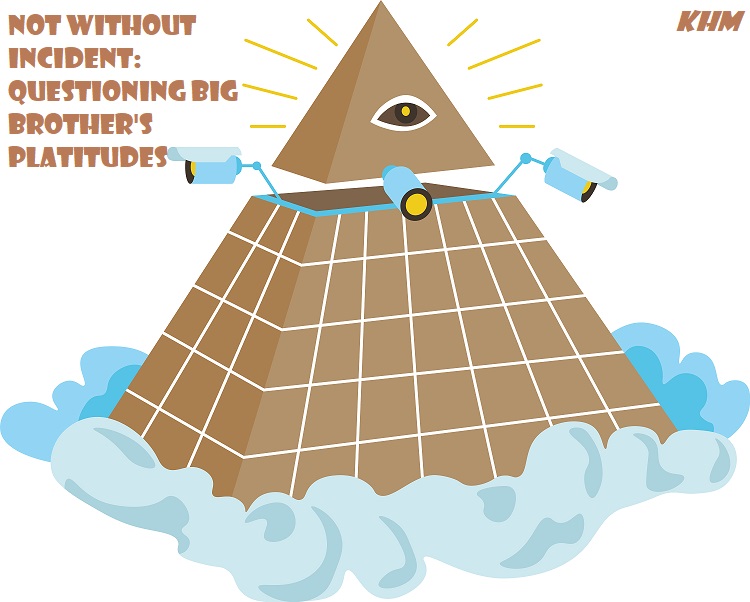
The first part of my new title, “Not Without Incident”, refers to a line from the 2002 film Equilibrium.[viii] In this film, John Preston serves as a high ranking grammaton cleric. Grammaton clerics serve ‘Father’, a version of Orwell’s Big Brother. Equilibrium is set in a totalitarian society that, after World War Three, has banned all emotion and the government hunts down what it calls ‘sense offenders’, and these include cultural artifacts like paintings, books, and music. People who do not comply with the orders of Father or a group of rebels who dwell underground and fight to bring down Father. In the final scenes of the film, Preston is tricked into exposing the underground rebellion and he goes rogue and makes his way through to Father, slaying all in his way. Before he does so, he is asked by Father that he come to him without incident. Preston replies “No, not without incident.”, and mayhem ensues. I’ve chosen this as my title because I could follow a specific political faction and abide by their ideology and arguments, or I could follow my own path and deviate from traditional ideological factions. As I set out to establish myself as a political commentator and scholar, I can choose between coming with or without incident. Thus, this title marks the choice that I have made.
The second part of the title, “Questioning Big Brother’s Platitudes”, refers to my primary goal, to challenge what is said unthinkingly and as if it’s fact, and not the result of years of indoctrination, The Big Brother we face is not the same as Orwell’s, nor is it the Father from equilibrium, or any of the various totalitarian parties depicted in film and literature, all interpretations or reimagining of Orwell and Aldous Huxley’s vision of an authoritarian society. Our Big Brother does not have a face, name, or identity of any sort. Our Big Brother is served by the permanent regime in the US and on an international level by the illiberal liberal globalist class and the transnational security elite.
The logo I have chosen to represent my blog’s new title and concept is a blend of conspiracy theorizing and truth seeking. The pyramid symbolizes the notion of the illuminati and it’s seeing eye. The security cameras built into it are its other eyes. It is a fusion of conspiracism and the truth of surveillance and thought policing in Western states, as we are all being watched. This logo is also inspired by the few times I have been called a conspiracy theorist. To some I will sound like a nut with a tinfoil hat. In response I would refer to a point by made by Robert Anton Wilson that “We all see only that which we are trained to see.”[ix] The dogma of Western exceptionalism is a wrecking ball that wreaks havoc across the globe. It is the ideology of our Big Brother, whose tentacles extend into universities, governments, the security state, and all the institutions that were at one point considered liberal and are now seen as bastions of leftism and radical activism by the conservative elite, who decry progressivism and its ideological outgrowths, like trans ideology.
My questioning will not make sense to those looking to see whose side I’m on. My goal is not to join a tribe, it is to, as Noam Chomsky said is the duty of intellectuals, “to speak the truth and expose lies.”[x] If this makes me an outcast, so be it. This is my political and intellectual journey so far, and it is far from over. As Kurt Vonnegut writes throughout Slaughterhouse-Five to mark transitions between accounts of death, dying, and other shocking horrors, “So it goes.”[xi]
[i] Orwell, George. Down and out in Paris and London. S.L.: Harvill Secker, 1933.
[ii] Bullmore, Joseph. “‘Work Is the Greatest Painkiller Known to Man…’ at Home with Marco Pierre White.” The Gentleman’s Journal, 2012. https://www.thegentlemansjournal.com/article/work-is-the-greatest-painkiller-known-to-man-at-home-with-marco-pierre-white/.
[iii] Orwell. Why I Write. 1946. Reprint, New York: Penguin Books, 2005.
[iv] Ratatouille. United States: Buena Vista Pictures Distribution, 2007.
[v] Davies, Dave, and Anthony Bourdain. “Anthony Bourdain on ‘Appetites,’ Washing Dishes and the Food He Still Won’t Eat.” NPR. Fresh Air, October 20, 2017. https://www.npr.org/2017/10/20/558792269/anthony-bourdain-on-appetites-washing-dishes-and-the-food-he-still-wont-eat#:~:text=BOURDAIN%3A%20At%20its%20root%2C%20it
[vi] Aristotle. Aristotle’s “Politics.” University of Chicago Press, 2013.
[vii] Wilson, Robert Anton. Cosmic Trigger: Final Secret of the Illuminati. Grand Junction, Colorado: Hilaritas Press, 2016.
[viii] Equilibrium. United States: Miramax Films, 2002.
[ix] Wilson, Robert Anton. Masks of the Illuminati. Dell, 2009.
[x] Chomsky, Noam. Responsibility of Intellectuals. The New Press, 2017.
[xi] Vonnegut, Kurt. Slaughterhouse-Five. 1969. Reprint, New York: Dial Press Trade Paperbacks, 2009.
References
Aristotle. Aristotle’s “Politics.” University of Chicago Press, 2013.
Bullmore, Joseph. “‘Work Is the Greatest Painkiller Known to Man…’ at Home with Marco Pierre White.” The Gentleman’s Journal, 2012. https://www.thegentlemansjournal.com/article/work-is-the-greatest-painkiller-known-to-man-at-home-with-marco-pierre-white/.
Chomsky, Noam. Responsibility of Intellectuals. The New Press, 2017.
Davies, Dave, and Anthony Bourdain. “Anthony Bourdain on ‘Appetites,’ Washing Dishes and the Food He Still Won’t Eat.” NPR. Fresh Air, October 20, 2017. https://www.npr.org/2017/10/20/558792269/anthony-bourdain-on-appetites-washing-dishes-and-the-food-he-still-wont-eat#:~:text=BOURDAIN%3A%20At%20its%20root%2C%20it.
Equilibrium. United States: Miramax Films, 2002.
Orwell, George. Down and out in Paris and London. S.L.: Harvill Secker, 1933.
———. Why I Write. 1946. Reprint, New York: Penguin Books, 2005.
Ratatouille. United States: Buena Vista Pictures Distribution, 2007.
Vonnegut, Kurt. Slaughterhouse-Five. 1969. Reprint, New York: Dial Press Trade Paperbacks, 2009.
Wilson, Robert Anton. Cosmic Trigger: Final Secret of the Illuminati. Grand Junction, Colorado: Hilaritas Press, 2016.
Wilson, Robert Anton. Masks of the Illuminati. Dell, 2009.
 Not Without Incident: Questioning Big Brother's Platitudes
Leave a comment